Will Data Analytics Be Replaced by AI? The Truth About the Future of Data Analysis
The question keeping many business owners awake at night isn't whether AI will change their industry—it's whether will data analytics be replaced by AI entirely, making their current analytics investments obsolete.
Here's the direct answer: AI won't replace data analytics. Instead, it's transforming how we approach data analysis, making it more powerful and accessible than ever before.
Key Takeaways
• AI enhances rather than replaces data analytics, automating routine tasks while humans focus on strategic insights
• Human expertise remains critical for context, business judgment, and interpreting complex patterns
• The future belongs to hybrid approaches that combine AI efficiency with human intelligence
• Small and medium businesses benefit most from AI-powered analytics tools that were previously enterprise-only
• Now is the time to adapt, not resist—businesses embracing AI-enhanced analytics gain competitive advantages
The Real Story: AI as Enhancement, Not Replacement

Let's cut through the hype and look at what's actually happening in 2026.
AI isn't replacing data analytics. It's making it better.
Think of it this way: calculators didn't replace mathematicians. They freed them from tedious arithmetic so they could solve bigger problems.
AI handles the heavy lifting. It processes massive datasets in seconds. It spots patterns humans might miss. It automates repetitive reporting tasks.
Humans provide the context. They understand what the business actually needs. They know when something doesn't make sense. They make the final decisions.
This partnership is already happening. Companies using AI-enhanced analytics report faster insights and better decision-making. They're not firing their analysts—they're making them more effective.
How AI Is Transforming Data Analytics (Not Replacing It)
Automation of Routine Tasks
AI excels at the boring stuff.
Data cleaning used to eat up 80% of an analyst's time. Now AI handles most of it automatically. It identifies outliers, fixes formatting issues, and flags potential errors.
The result? Analysts spend more time analyzing and less time preparing data.
Pattern Recognition at Scale
Humans are great at spotting obvious trends. AI finds the subtle ones.
It can analyze thousands of variables simultaneously. It identifies correlations that would take humans weeks to discover. It processes real-time data streams without breaking a sweat.
But here's the key: AI finds patterns. Humans decide what they mean.
Predictive Analytics for Everyone
Advanced forecasting used to require PhD-level expertise. Not anymore.
AI democratizes predictive analytics. Small businesses can now access sophisticated forecasting tools. They can predict customer behavior, inventory needs, and market trends.
The analytics dashboard you use today is likely powered by AI—you just don't see it working behind the scenes.
Will Data Analytics Be Replaced by AI? Why Human Expertise Still Matters
Business Context Is Everything
AI processes data. Humans understand business.
When sales drop in Q3, AI can tell you it happened. A human analyst knows it's because the new competitor launched, the supply chain had issues, or the marketing campaign flopped.
Context turns data into insight. And context requires human understanding.
Complex Decision Making
Data informs decisions. It doesn't make them.
Should you enter a new market? Launch a new product? Change your pricing strategy?
These decisions involve risk, timing, company culture, and dozens of other factors that don't show up in datasets.
AI provides the information. Humans make the judgment calls.
Creative Problem Solving
The best analytics insights come from asking the right questions.
AI is excellent at answering questions. It's not great at knowing which questions to ask.
Humans bring curiosity, creativity, and business intuition to the process. They know when to dig deeper or look in unexpected places.
The Future of Data Analytics: Human-AI Collaboration
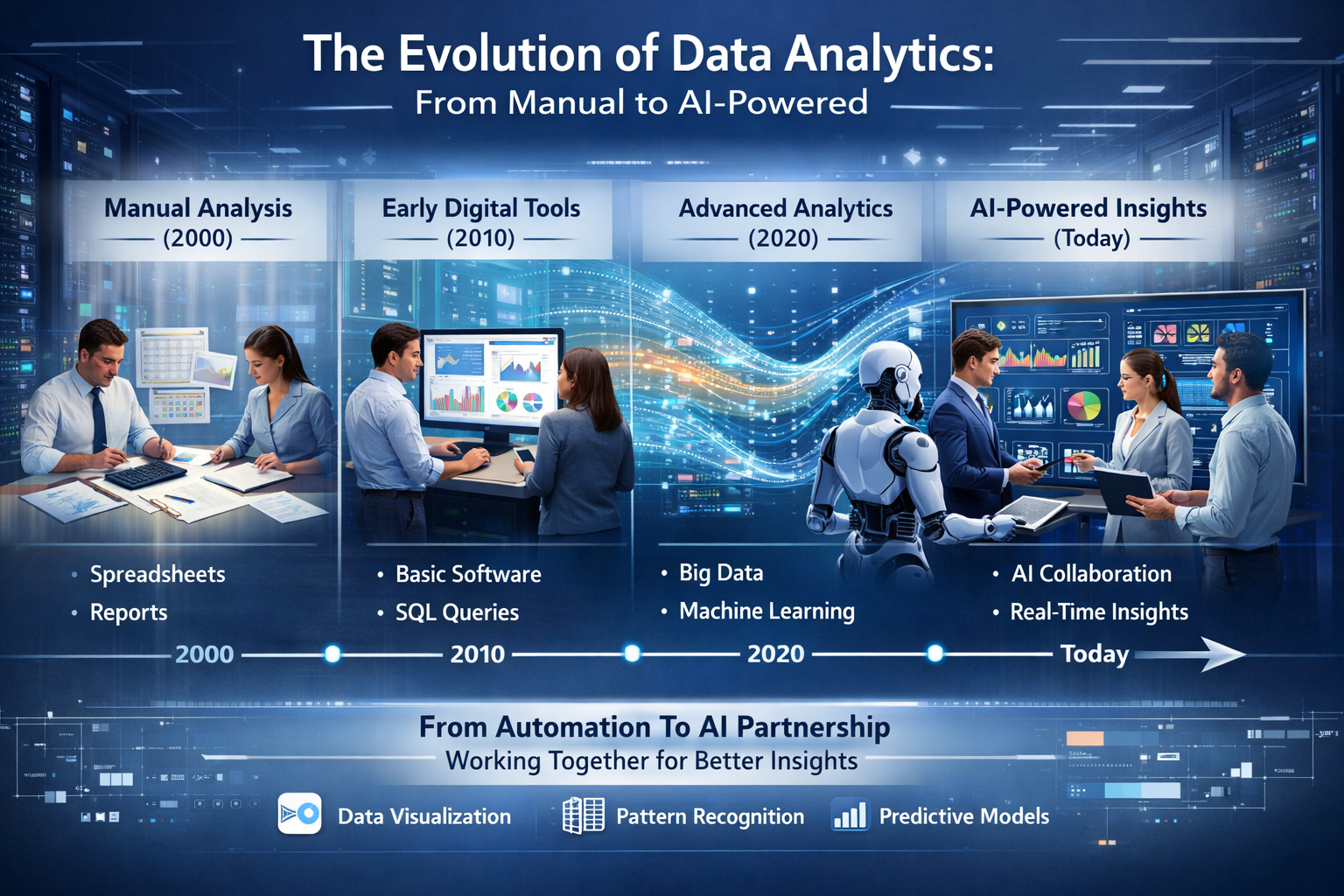
What This Means for Your Business
The companies winning with analytics in 2026 aren't choosing between humans and AI. They're combining both.
Small businesses benefit most. AI tools level the playing field. You can now access enterprise-level analytics without enterprise budgets.
Medium businesses scale faster. AI handles the routine work while your team focuses on strategy and growth.
The key is starting now. The learning curve exists, but it's manageable. And the competitive advantage is real.
Practical Steps to Take Today
Don't wait for perfect clarity. Start experimenting.
Begin with simple automation. Use AI-powered tools for basic reporting and data cleaning. See how much time you save.
Focus on your biggest pain points. Where does your team spend too much time on routine tasks? That's where AI can help first.
Invest in your people. Train your team on AI-enhanced tools. The combination of human insight and AI efficiency is unbeatable.
Consider exploring partnership opportunities with analytics providers who understand this hybrid approach.
Skills That Matter Going Forward
The analysts thriving in 2026 aren't the ones fighting AI. They're the ones working with it.
Business acumen matters more than ever. Understanding your industry, customers, and competitive landscape becomes the differentiator.
Communication skills are crucial. Turning insights into action requires explaining complex findings to non-technical stakeholders.
Adaptability is essential. The tools keep evolving. The willingness to learn and experiment determines success.
Common Concerns About AI in Analytics
"Will AI Make Mistakes?"
Yes, AI makes mistakes. So do humans.
The difference? AI mistakes are often systematic and detectable. Human mistakes are often random and harder to spot.
The solution isn't avoiding AI. It's understanding its limitations and building appropriate checks.
"Is My Data Safe?"
This is a legitimate concern that requires careful consideration.
Modern AI analytics tools offer robust security features. Many process data locally or use encrypted cloud environments.
Do your homework. Understand how your tools handle data. Read the privacy policies. Ask direct questions about security.
"Will This Make My Team Obsolete?"
Not if you handle the transition thoughtfully.
AI eliminates some tasks but creates new opportunities. Your team can focus on higher-value work: strategy, interpretation, and business development.
Frame it as evolution, not replacement. Help your team see AI as a powerful assistant, not a threat.
Making the Transition: Practical Next Steps
Start Small and Scale
Don't try to revolutionize everything at once.
Pick one area where AI can make an immediate impact. Maybe it's automated reporting. Perhaps it's customer segmentation.
Get comfortable with the technology. Build confidence through small wins before tackling bigger challenges.
Choose the Right Tools
Not all AI analytics tools are created equal.
Look for solutions that integrate with your existing systems. Prioritize ease of use over fancy features. Focus on solving real business problems.
Test before you commit. Most quality providers offer trials or demos. Use them.
Plan for Change Management
Your team's success with AI depends on how you introduce it.
Be transparent about the changes. Explain why you're adopting AI and how it benefits everyone.
Provide adequate training. Don't assume people will figure it out on their own.
Celebrate early wins. Show how AI-enhanced analytics delivers better results.
If you need guidance on implementation, consider reaching out through the contact page to discuss your specific situation.
Conclusion: Embracing the AI-Enhanced Future
The question "will data analytics be replaced by AI" misses the point entirely.
AI isn't replacing data analytics—it's making it more powerful, accessible, and valuable than ever before.
The real opportunity lies in combination. AI handles the routine work. Humans provide context, creativity, and judgment. Together, they deliver insights that neither could achieve alone.
The time to start is now. The tools are ready. The competitive advantages are real. The learning curve is manageable.
Don't wait for perfect clarity or complete certainty. Start experimenting with AI-enhanced analytics today. Begin with simple automation. Focus on real business problems. Invest in your team's development.
The future belongs to businesses that embrace this partnership between human intelligence and artificial intelligence. Make sure yours is one of them.
Ready to explore AI-enhanced analytics for your business? Get started today and see how the combination of human insight and AI efficiency can transform your decision-making process.
Meta Title: Will Data Analytics Be Replaced by AI? The 2026 Truth
Meta Description: Discover why AI enhances rather than replaces data analytics. Learn how human-AI collaboration creates competitive advantages for smart businesses in 2026.
Other frequently asked questions
- How Do I Check Which Pages People Spend the Most Time On
- How Do I Track Sales From My Google Ads Campaigns
- Will AI Take Over Data Analytics
- How Do I Track Phone Calls or Email Clicks as Conversions
- How Do I Track How Many People Fill Out My Contact Form
- How Do I Track How Many People Watch a Video or Download a Brochure
- How Do I Know Which Pages Lead to the Most Conversions
- How Do I See Where Most People Drop Off During Checkout
- How Do I See Where My Website Visitors Are Coming From
- How Do I See Which Blog Posts Bring Me the Most Visitors
- How Do I Check if My Homepage Is Actually Performing Well
- How Do I Find Out How Long It Takes Someone to Become a Customer
- How Do I Find Out What Paths People Take Before They Buy or Sign Up
- How Do I Measure Which Traffic Source Brings the Most Paying Customers
- How Do I See if Discounts or Offers Increase Sales
- How to See What Visitors Do First When They Land on Your Site