How Do I See If Discounts or Offers Increase Sales? A Practical Guide for Business Owners
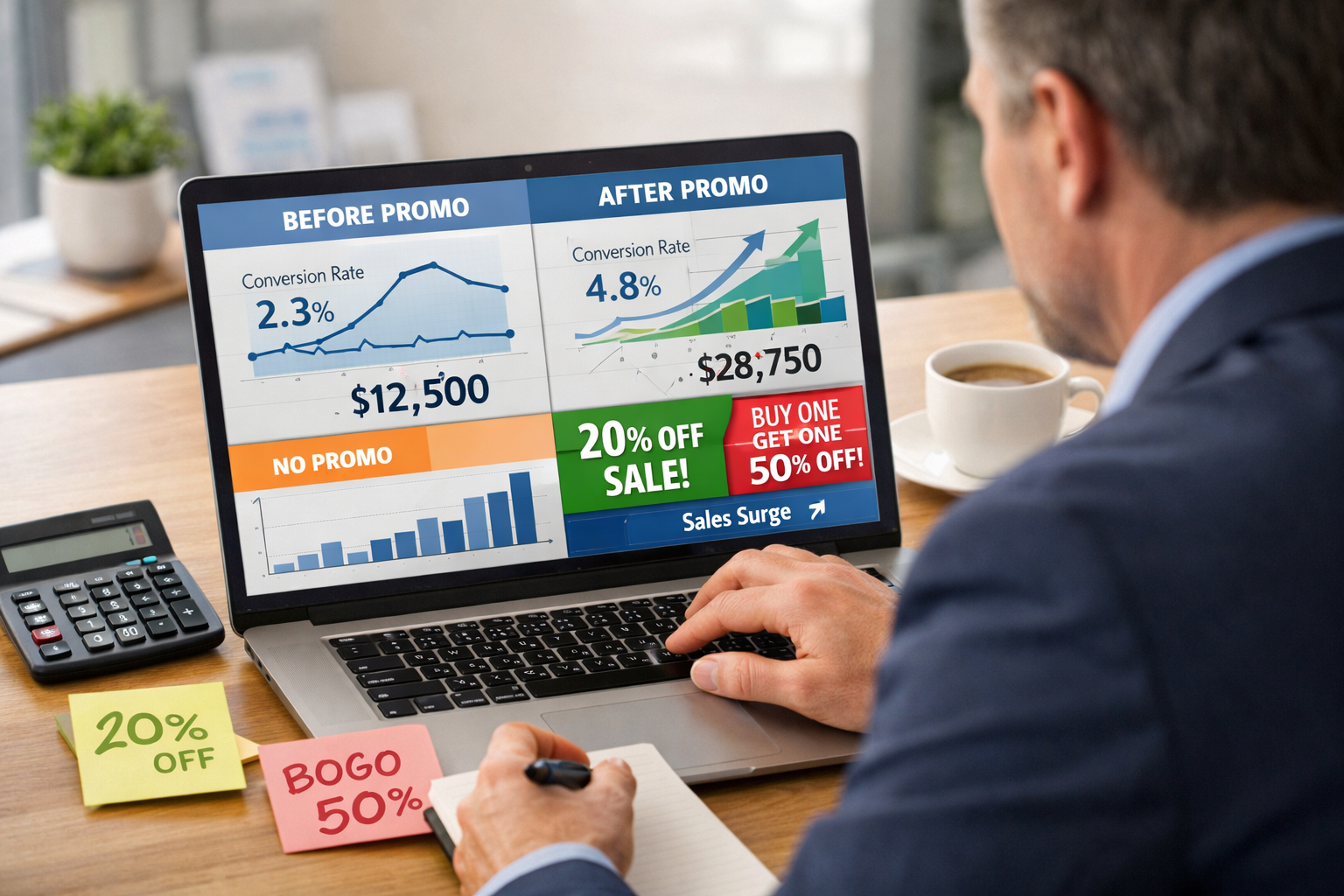
Running a discount sounds simple. Customers get a deal, sales go up, everyone wins.
Except you don't always know if that's what actually happened.
You might see a spike in orders during a promotion. But did the discount create new revenue, or did it just pull forward purchases that would have happened anyway? Did it attract bargain hunters who'll never return, or did it build a base of loyal customers?
The difference matters. One scenario grows your business. The other just discounts your margins.
Understanding whether discounts or offers increase sales requires more than watching order counts tick up. It requires connecting the dots between what you offered, who responded, and what happened to your revenue afterward.
This guide walks through the practical steps to measure promotional impact without needing a data science degree.
Key Takeaways
- Revenue is the metric that matters most—not clicks, impressions, or even order volume alone
- Compare sales during promotional periods to baseline performance to isolate the actual impact of your discount
- Track customer behavior after the promotion ends to determine if discounts build loyalty or attract one-time buyers
- Connect promotional data to inventory turnover and profit margins to ensure discounts don't erode profitability
- Use simple tracking systems and dashboards to monitor what's working without getting overwhelmed by data
Why Measuring Promotional Impact Actually Matters
Most business owners run discounts because they feel like they should.
A competitor offers 20% off. A holiday approaches. Sales slow down. The instinct is to discount.
But discounts cost money. Every percentage point off is margin you're giving away. If that discount doesn't generate enough additional revenue to justify the loss, you're just making less money on the same sales.
Here's the reality: 51% of small businesses report discounts as their most effective revenue driver during promotional periods[1]. That's significant. But it also means nearly half don't see the same results.
The difference between those two groups isn't luck. It's measurement.
When you track whether discounts or offers increase sales in your specific business, you stop guessing and start optimizing. You learn which promotions work, which customers respond, and which offers just train people to wait for the next sale.
Start With Revenue, Not Vanity Metrics
The first rule of measuring promotional effectiveness is simple.
Focus on revenue.
Not traffic. Not email open rates. Not social media engagement.
Revenue is what pays the bills. Everything else is just a leading indicator that may or may not convert.
When evaluating whether discounts or offers increase sales, compare total revenue during the promotional period to your baseline. Your baseline is what you would have earned without the promotion.
Here's a simple framework:
Baseline Revenue = Average daily/weekly revenue from the same period last year (or the previous month if seasonal patterns don't apply)
Promotional Revenue = Actual revenue during the discount period
Incremental Revenue = Promotional Revenue - Baseline Revenue - Cost of Discount
If incremental revenue is positive and meaningful, the promotion worked. If it's negative or barely positive, it didn't.
This approach cuts through the noise. A promotion that generates 100 extra orders but costs more in discounts than it generates in new revenue is a failure, even if it feels busy[1].
Track Customer Behavior Before, During, and After
Revenue tells you what happened. Customer behavior tells you why.
To truly understand if discounts or offers increase sales, you need to track three distinct periods:
Before the Promotion
Establish your baseline. What were customers buying? How often? At what average order value?
This context matters. If your average customer buys every 60 days, and you run a promotion on day 55, you're not creating new demand. You're just discounting a purchase that was about to happen anyway.
During the Promotion
Watch who responds. Are these existing customers or new ones? Are they buying more than usual, or just buying earlier?
70% of holiday shoppers actively seek deals[1], which means promotional timing matters enormously. But it also means discounts during peak shopping periods face more competition.
Track engagement patterns closely. Digital tools reveal which customers accessed promotional materials, how long they spent reviewing offers, and which products they ultimately purchased[5]. This data predicts conversion outcomes with surprising accuracy.
After the Promotion
This is where most businesses stop tracking. That's a mistake.
The real question isn't whether a discount drove a sale. It's whether that sale led to a customer relationship.
88% of customers are likely to become repeat buyers after a positive experience[1]. If your discount attracted customers who return and buy at full price, it was an investment. If it attracted bargain hunters who disappear until the next sale, it was just a margin giveaway.
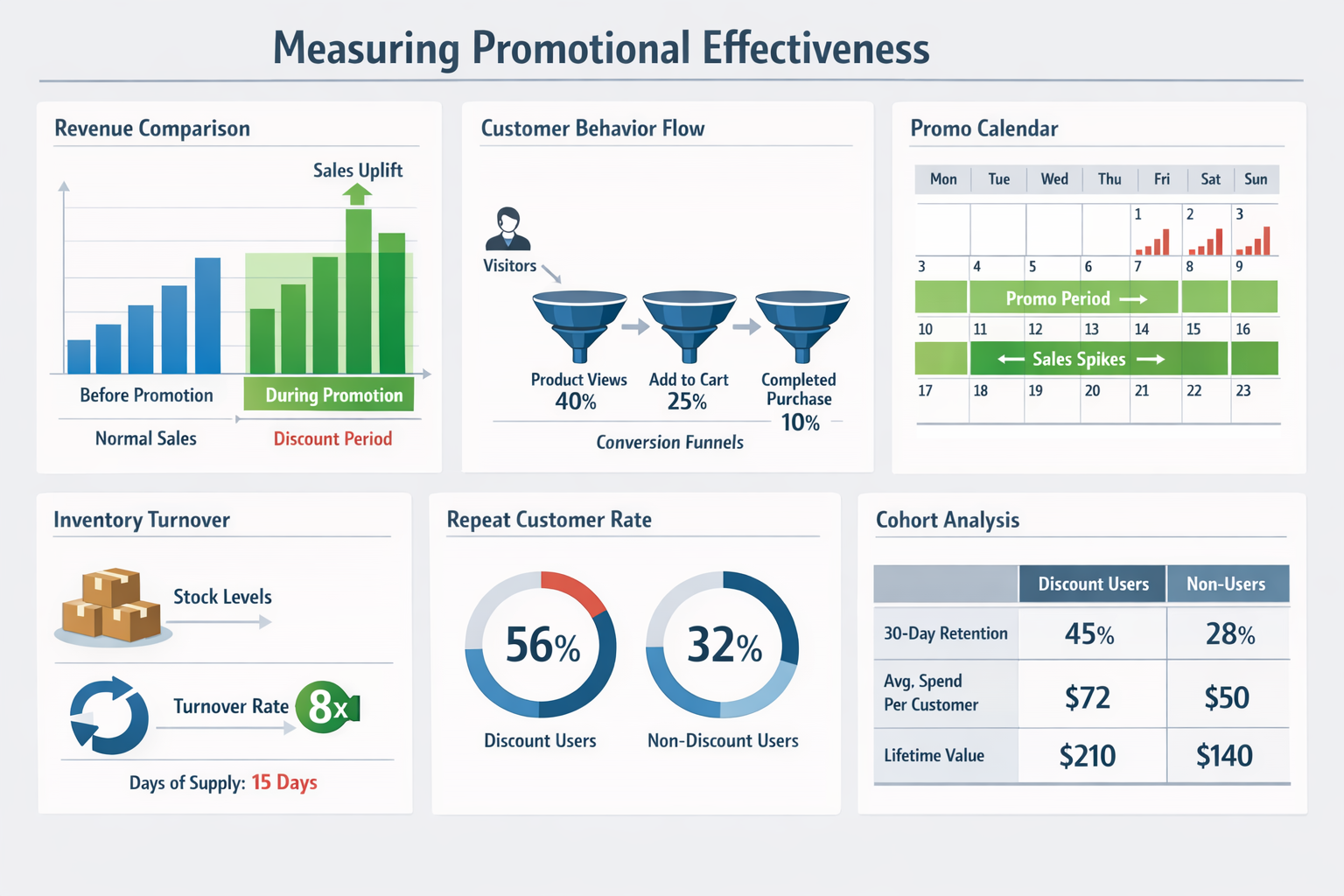
Track repeat purchase rates by cohort. Compare customers acquired during promotional periods to those acquired at full price. The difference will tell you whether your discounts build value or destroy it.
Connect Promotions to Inventory and Profitability
Sales numbers don't exist in isolation.
A discount that moves inventory you were going to mark down anyway is valuable. A discount that trains customers to wait for sales on your best-selling, full-margin products is destructive.
In 2026, successful retailers measure sales per square meter per segment and track the reduction of forced markdowns[6]. The goal isn't just to move product. It's to move the right product at the right time at the right price.
Here's what to monitor:
- Inventory turnover during promotional periods - Did the discount clear slow-moving stock or just discount fast-sellers?
- Margin erosion - What was your gross profit during the promotion versus baseline periods?
- Product mix shifts - Did customers trade down to discounted items from higher-margin alternatives?
Dynamic pricing and data-led promotions help maintain cost discipline[4]. Instead of blanket discounts, target specific products, customer segments, or inventory situations where a promotion genuinely solves a business problem.
Value-based customer segmentation reduces reliance on heavy discounts[6]. When you match product assortment to customer demographics and buying patterns, you improve turnover without needing to slash prices.
Use Simple Systems to Track What Matters
You don't need enterprise analytics to measure promotional impact.
You need a system that connects three things:
- When promotions ran (dates, discount amounts, channels)
- What revenue resulted (total sales, new versus returning customers, product mix)
- What happened next (repeat purchases, margin impact, inventory movement)
A simple dashboard that displays these metrics side by side gives you the insight you need. The sophistication isn't in the technology. It's in asking the right questions.
Most small businesses already have access to the data. It's sitting in their e-commerce platform, point-of-sale system, or accounting software. The challenge is pulling it together in a way that makes patterns visible.
Set up weekly or monthly reporting that shows:
- Revenue during promotional periods versus baseline
- Customer acquisition cost during promotions
- Repeat purchase rate by acquisition source
- Gross margin by promotional type
When you review these metrics consistently, patterns emerge. You'll see which promotions genuinely drive incremental revenue and which just shift timing or erode margins.
Test Different Promotional Approaches
Not all discounts work the same way.
Static "percent off" messaging fatigues consumers. In 2026, interactive and timely offers outperform generic discounts[3]. Promotions that feel earned, timely, or exciting capture significantly more attention than blanket price cuts.
Consider testing:
Event-based promotions - Tie discounts to external events (sports outcomes, weather milestones, cultural moments). These create excitement and offer large perceived value without guaranteed cost[3].
Conditional offers - Require specific actions (minimum purchase, product bundles, referrals) to unlock discounts. This increases average order value while providing the discount.
Tiered discounts - Reward larger purchases with steeper discounts. This encourages customers to buy more while protecting margins on smaller transactions.
Time-limited flash sales - Create urgency without training customers to always expect discounts.
Loyalty-based offers - Reserve best discounts for repeat customers, reinforcing the behavior you want.
Track each approach separately. Measure not just immediate revenue impact, but customer lifetime value by acquisition method.
The goal is to find promotional strategies that increase sales while building customer relationships and protecting profitability.
Build a Measurement Habit, Not Just a Promotion
The businesses that succeed with discounts don't just run promotions.
They build measurement into their operational rhythm.
Every promotion becomes a test. Every test generates data. Every data point informs the next decision.
This isn't complicated. It's disciplined.
Before launching a promotion, define what success looks like. Set specific targets for incremental revenue, customer acquisition, or inventory movement.
During the promotion, monitor performance in real-time. If something isn't working, adjust or stop.
After the promotion, review results against targets. Document what worked, what didn't, and why.
72% of customers return to the same small businesses each holiday season[1]. This loyalty is built through positive experiences, not just low prices. When you measure promotional impact holistically—including customer satisfaction, repeat rates, and profitability—you optimize for long-term growth, not just short-term spikes.
Integrated reporting that connects promotions to sales data and customer behavior is essential[1]. Small businesses that master this connection optimize return on investment and build sustainable competitive advantages.
If you're looking to implement better tracking and measurement systems, getting started with the right tools makes the process significantly easier.
Common Mistakes That Distort Promotional Measurement
Even with good intentions, measurement can mislead.
Here are the traps to avoid:
Mistaking correlation for causation - Sales might increase during a promotion because of seasonality, external events, or marketing efforts unrelated to the discount. Always compare to baseline periods that account for these factors.
Ignoring customer lifetime value - A promotion that loses money initially but acquires high-value repeat customers is successful. One that generates immediate profit from one-time buyers who never return is not.
Focusing only on revenue - Revenue without profit is just busy work. Always track margin impact alongside sales volume.
Not segmenting results - Aggregate numbers hide important patterns. Break down results by customer type, product category, and acquisition channel.
Measuring too soon - The full impact of a promotion often takes weeks or months to materialize as repeat purchases occur (or don't).
Changing too many variables at once - If you run a discount, launch new marketing, and introduce new products simultaneously, you can't isolate what drove results.
The solution to all these mistakes is the same: systematic tracking with clear baselines and controlled variables.
What Good Promotional Measurement Looks Like in Practice
Let's make this concrete.
Imagine you run an online store selling home goods. You're considering a 25% off promotion for the upcoming holiday weekend.
Before the promotion, you establish:
- Average daily revenue for the past month: $2,000
- Average order value: $75
- Typical repeat purchase rate: 30% within 90 days
- Gross margin: 40%
During the promotion, you track:
- Total revenue: $8,000 over three days
- Number of orders: 120
- New customers: 80
- Returning customers: 40
- Average order value: $67
After the promotion (90 days later), you measure:
- Repeat purchases from promotion customers: 20 out of 120 (16.7%)
- Revenue from those repeat purchases: $1,200
- Margin on promotional sales: 15% (40% baseline - 25% discount)
Analysis:
Expected revenue without promotion: $6,000 (3 days × $2,000)
Actual revenue: $8,000
Incremental revenue: $2,000
Margin on incremental sales: $300 (15% of $2,000)
Repeat customer value: $1,200 at 40% margin = $480 additional profit
Total promotional ROI: $780 profit on $2,000 in incremental discounted sales
But you also notice the repeat purchase rate dropped from 30% to 16.7% for promotion customers. This suggests the discount attracted more price-sensitive buyers who are less likely to become loyal customers.
Decision: The promotion was marginally profitable but didn't build the customer base as effectively as full-price sales. Future promotions should be smaller (15% instead of 25%) or more targeted (new customer acquisition only, loyalty rewards for existing customers).
This is what measurement looks like in practice. Numbers connected to decisions.
Moving Forward: Making Measurement Sustainable
Understanding whether discounts or offers increase sales isn't a one-time project.
It's an ongoing practice that becomes easier and more valuable over time.
Start simple. Pick one or two key metrics. Track them consistently. Build from there.
The businesses that win with promotions in 2026 aren't the ones with the biggest discounts. They're the ones with the clearest understanding of what works, for whom, and why.
They know their numbers. They test systematically. They optimize continuously.
You can do the same.
The tools exist. The data is available. What's needed is the discipline to connect promotional activity to business outcomes and the willingness to let results guide decisions.
When you measure correctly, discounts stop being a desperate tactic and become a strategic tool. You'll know when to use them, how deep to go, and which customers to target.
That knowledge is worth far more than any single promotion.
Conclusion
Knowing whether discounts or offers increase sales transforms how you run promotions.
Instead of copying competitors or following seasonal patterns blindly, you make decisions based on what actually works in your business, with your customers, for your products.
The measurement process isn't complicated:
Track revenue against meaningful baselines. Monitor customer behavior before, during, and after promotions. Connect promotional activity to inventory movement and profitability. Test different approaches systematically. Build measurement into your operational rhythm.
The businesses that master this process don't just run better promotions. They build more profitable, sustainable operations that grow without constantly eroding margins.
Start with one promotion. Measure it properly. Learn from the results. Repeat.
Over time, you'll develop an intuition for what works. But that intuition will be grounded in data, not guesswork.
If you need help setting up tracking systems or want to explore tools that make measurement easier, reach out or explore available resources designed specifically for business owners who want clarity without complexity.
The question isn't whether discounts can increase sales. They can. The question is whether they do in your specific situation, and whether that increase is worth the cost.
Now you know how to find out.
References
[1] Small Business Marketing Predictions For 2026 - https://www.globaltrademag.com/small-business-marketing-predictions-for-2026/
[3] Promotional Marketing In 2026 Where Engagement Risk And Experience Converge - https://scapromotions.com/2026/01/05/promotional-marketing-in-2026-where-engagement-risk-and-experience-converge/
[4] Retail Distribution Industry Outlook - https://www.deloitte.com/us/en/insights/industry/retail-distribution/retail-distribution-industry-outlook.html
[5] Sales Trends - https://monday.com/blog/crm-and-sales/sales-trends/
[6] 7 Predictions Will Define Retail 2026 - https://www.flipflow.io/en/blog-en/7-predictions-will-define-retail-2026/
SEO Meta Title and Description
Meta Title: How to See If Discounts or Offers Increase Sales (2026)
Meta Description: Learn practical methods to measure if discounts or offers increase sales. Track revenue, customer behavior, and profitability with simple systems.
Other frequently asked questions
- How Do I Check Which Pages People Spend the Most Time On
- How Do I Track Sales From My Google Ads Campaigns
- Will AI Take Over Data Analytics
- How Do I Track Phone Calls or Email Clicks as Conversions
- How Do I Track How Many People Fill Out My Contact Form
- How Do I Track How Many People Watch a Video or Download a Brochure
- How Do I Know Which Pages Lead to the Most Conversions
- How Do I See Where Most People Drop Off During Checkout
- How Do I See Where My Website Visitors Are Coming From
- How Do I See Which Blog Posts Bring Me the Most Visitors
- How Do I Check if My Homepage Is Actually Performing Well
- How Do I Find Out How Long It Takes Someone to Become a Customer
- How Do I Find Out What Paths People Take Before They Buy or Sign Up
- How Do I Measure Which Traffic Source Brings the Most Paying Customers
- How Do I See if Discounts or Offers Increase Sales
- How to See What Visitors Do First When They Land on Your Site